A bioinformatician is analyzing a DNA sample composed of multiple sequence fragments.
Each fragment:
- starts and ends at specific positions on the genome,
- has a quality score (indicating its reliability).
However, some fragments overlap — and only one fragment can be selected from any overlapping region.
The goal is to select a subset of non-overlapping fragments that maximizes the total quality score.
Problem Description
You are given n DNA fragments.
Each fragment i is described by:
- a start position
s_i - an end position
f_i - a quality score
w_i
Compute the maximum total quality achievable by selecting non-overlapping fragments.
Example
Input
(1, 3, 5)
(2, 5, 6)
(4, 6, 5)
(6, 7, 4)
Each line represents: (start, end, weight).
Output
10
Explanation
- You can select fragment 1
(1–3, weight 5), fragment 3(4–6, weight 5)and fragment 4(6–7, weight 4). - They do not overlap, and their total score is
5 + 5 + 4 = 14. - This is the optimal configuration.
Function Description
Implement the following function:
class Job:
	def __init__(self, start, finish, profit):
		self.start = start
		self.finish = finish
		self.profit = profit

def maxFragmentQuality(intervals: Jobs) -> int:
    # Write your code here
Parameters
intervals: a list of tuples(start, end, weight)representing fragments
Returns
int: maximum achievable total quality (sum of weights)
💡 Modeling Hint
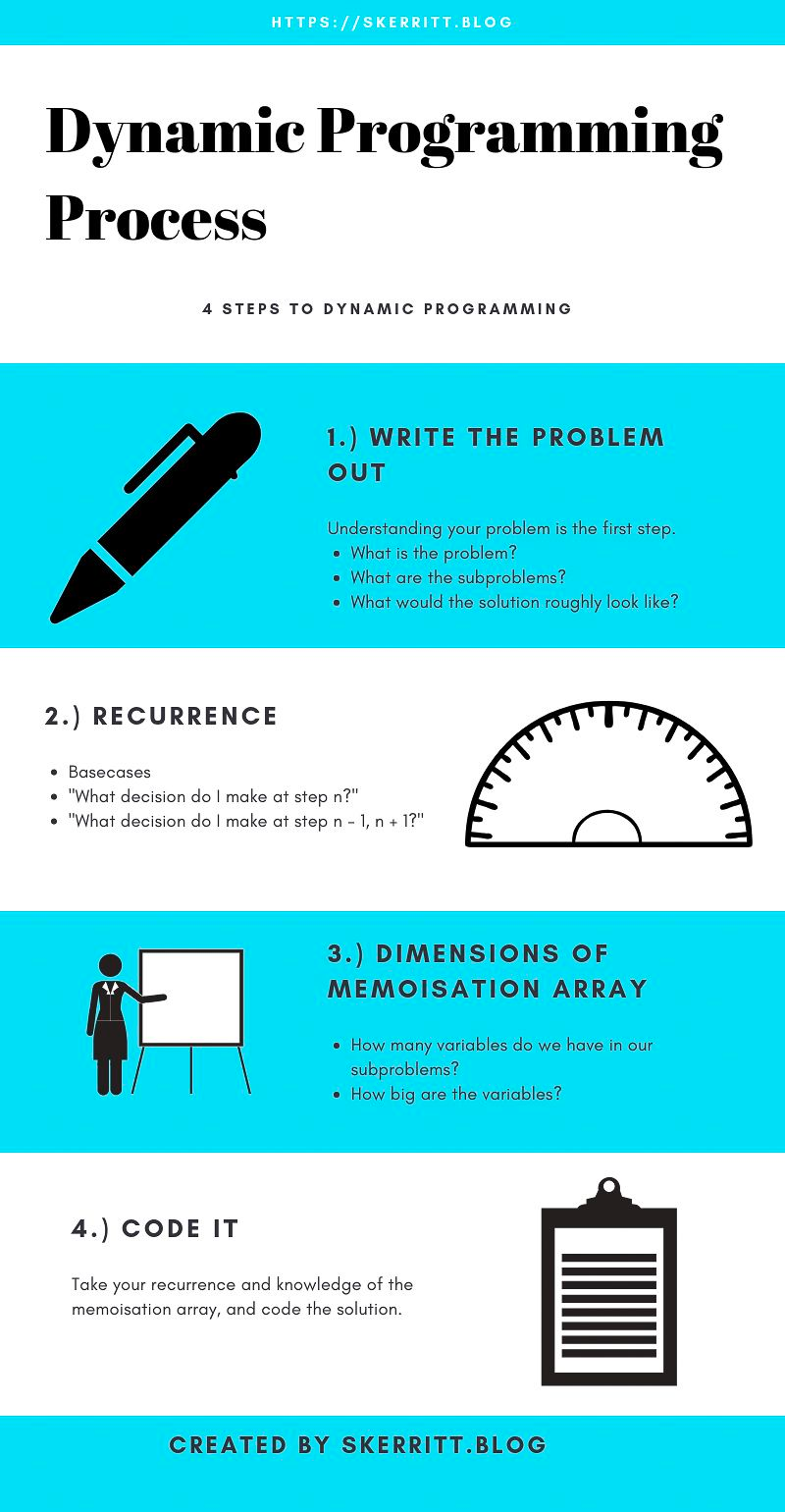
Weighted DNA Fragment Selection - GUIDED
Guided steps
-
Sort the fragments by end position (to sort
Jobobjects use the functionsortedproperly settingkey). -
For each fragment
i, find the last fragmentp(i)that finishes beforeistarts. -
Define:
where:
dp[i]= best total quality considering the firstifragments,dp[p(i)]= best total quality up to the last non-overlapping fragment.
Use a 1D array dp for tabulation.
Use these parts in python
# A Binary Search based function to find the latest job
# (before current job) that doesn't conflict with current
# job. "index" is index of the current job. This function
# returns -1 if all jobs before index conflict with it.

def binarySearch(jobs, start_index):
	# Initialize 'lo' and 'hi' for Binary Search
	lo = 0
	hi = start_index - 1
	# Perform binary Search iteratively
	while lo <= hi:
		mid = (lo + hi) // 2
		if jobs[mid].finish <= jobs[start_index].start:
		if jobs[mid + 1].finish <= jobs[start_index].start:
		lo = mid + 1
		else:

			return mid
		else:
			hi = mid - 1
	return -1


# Driver code to test above function
jobs = [Job(1, 2, 50), Job(3, 5, 20), Job(6, 19, 100), Job(2, 100, 200)]
print("Optimal profit is"),
print(schedule(jobs))